It's been roughly 8 months since the players took that left turn and decided to leave the Witchfire and the events of Vinter's invasion of the small town of Whitemarsh behind them, or so they thought. Over the months of gametime, news of Vinter's advancing forces and strike teams kept reaching the group. The Cleric decided to found a monument/stronghold and through the use of a Lyre of Construction aiding construction his monument is nearing completion years ahead of schedule. The other members have made themselves at home, some pursuing their own goals (the forged man ranger in particular is taking his hand at inventing and maybe by spring the first working davinci helicopters and tanks will see use).
Ever present though is the war and it has been pushing slowly east towards them. A few sessions ago it hit home, literally. Several strike teams of Vinter's commandos hit the stronghold with 2 war meks and did some damage before being routed and reporting back. The group learned eventually that Vahn Oberon (who they met in the Witchfire Trilogy) is looking to exterminate any Forged Men they find and the group's ranger has survived several encounters with hit squads already. In the last session, one of Vinter's expendable assassins was sent to kill the Cleric, but failed.
In a twist, she was given to a demon summoned by the Spellblade, who promptly ate her soul.
The group several times now has determined to go back to Whitemarsh but keeps getting sidetracked by more pressing matters, one of which was a Frost Giant spellcaster of some kind that found a way to breed sunlight resistant brown mold. Over a score of Apathos' Crusaders fell to the creature and the cold before the High Priest retreated and broods over his next step.
So far they count among their enemies and loose ends -
Haindrad - the Death Knight that took the Witch's Blade from them
Vinter the Elder - the cause of the war threatening them
Vahn Oberon - Vinter's right hand and who's men are trying to recover the Witches' Blade and kill off Forged Men
Whitemarsh Coven - the undead witches whose leader, Lexaria Cimmor swore vengeance on the party over killing her daughter and stealing the Witches Blade from.
Father Dumas - ever helpful to the party, but they discovered when they arrived in Pax Valis to the high church of Tymira the good father died 18 years past and was not raised
The Black Bastard - mysterious leader of the strongest crime organization in Whitemarsh
'Ember' - a mountain dragon they plundered the lair of, in the process killing Ember's 2 favorite squirrel pets
Saturday, January 25, 2014


Deck of Chance
Deck
of Chance: This deck of expensive-looking playing cards has only jokers,
aces and numbered cards 2 to 8’s. Once per day, any character can draw one card
from the deck. The number drawn, minus 4, is the adjustment the character takes
on all ‘to hit’ rolls, saving throws, AC and any skill-like rolls for 24 hours.
Aces count as 1’s and jokers count as 0’s.
Heart of Steel
Heart
of Steel: When placed on the chest of a Forged Man, the heart melds into
its chest cavity and grows connections throughout its body, resembling blood
vessels and veins. This increases a functioning (above 0 hit points) Forged
Man’s daily self repair ability by +2.
Flame Blade
Flame Blade: This specially
enchanted weapon is found as a hilt or handle made of darkwood. In the
hands of a Druid or Ranger the weapon’s head can be commanded to spring into
existence, composed of flames. The weapon gives off light as bright as a torch
and inflicts 3d4 fire damage per hit.
Armor of the Forest
Armor of the Forest: These suits of
Plate Mail are carved completely from darkwood, but have the strength and
flexibility of iron. When worn it functions like Plate Mail +1. When donned by
a Ranger it provides an armor class of 3[17] plus magical bonuses but possesses
the statistics of a Chain Shirt.
Guardian of Faith
Guardian of Faith
Spell Level:
Cleric 2
Range: 30 ft
Duration: 1 hour /
level
When this prayer
is uttered, the Cleric calls a minor servant of his Deity. The servant then
guards an area of 30 ft in radius around the target point of the spell. If any
creature moves into the protected area and is not an ally of the Cleric (the
Cleric can designate who may move freely in and out of the area), a glowing
knight of the Cleric’s faith appears before the intruder and attacks him as a 4
HD monster. If the guardian hits, the intruder must make a Toughness saving
throw or be paralyzed for 1d6+4 rounds. In any event, once the Guardian is
activated, the spell ends and the Cleric is made aware of the intruder.
Nimbus of Saints*
Nimbus of Saints*
Spell Level:
Cleric 3
Range: Self
Duration: 1 turn
When cast, a halo
of light (or darkness) forms over the Cleric’s head. For the spell’s duration,
any healing spell cast within 10 ft of the Cleric (including his own) gain an
extra die.
The reverse of this spell, Nimbus of Darkness, causes any reversed healing spell that inflicts damage cast within 10 ft of the Anti-cleric (including his own) to gain an extra die.
Wednesday, May 01, 2013
Condensed Campaign Update
As mentioned in the last post, my group has been in the wilderness travelling cross country for a few months of game time to get to the city of Pax Valis, Capitol of the Great Kingdom. They encountered mostly light fighting from monsters (thought carrying the Witchfire meant if they didn't destroy everything they killed right away, it would reanimate and start another fight), although there was an encounter with a group of undead giants, a clan of hill giants and a hidden temple of Demogorgon they tricked their way out of (especially fun because it involved some quick on their feet RP with an intelligent mutant 2-headed ape and some lucky reaction rolls).
I was looking ahead to the city. I don't normally run city adventures, they don't suit me as a referee so I was planning what to do next. Looking at my notes one night, I stumbled across an old Swords & Wizardry adventure I made 3 or 4 years ago with some of the current group's members. Low level wilderness and dungeon crawl, they inadvertently freed a Death Knight. He hung out for a few rounds while he got his bearings, fried some NPCs for good effect and put a whupping on a couple of PCs before using his Word of Recall ability to TP away. In life the Knight's religion was as a follower of the Deity of Lords and Rulers and he fell from grace not long before he died, was consequently entombed in what would have been the dungeon of the keep he was building for himself...where he had awoken as a Death Knight trapped by wards and barriers (until our unwitting heroes stumbled across him a few thousand years later).
Fast forward to now, the new group of totally different characters. They deliver the sword triumphantly to the High Priest of the Deity of Protection and Healing in the temple in Pax Valis. In the process, they find out that Alexia's uncle in the swamp city died shortly after the witch trials that killed her mother 10 years ago...that left them wondering who the good father really is since he was far from dead and no temple sanctioned resurrection was performed.
When they go to hand over the sword, one of the group's fighting-men lunges after it. She had been in contact with it and lost a contest of wills during the course of bringing it here, it decided if there was a chance, it would use her to escape the city and find a suitable wielder that didn't fight it so much. The sword clatters to the ground when she bull rushes the High Priest and the group restrains her as...
The Death Knight appears, setting off all sorts of wards and protective magic, sizzling and popping and bursting into holy flames. The group, filled with the horror of what they are witnessing, can't do anything to save the High Priest as the Death Knight reclaims his sword and slices down the man then exits out onto the street, leaving them with a sense of dread as he causes a commotion and then vanishes.
Once things calmed down (in game and around the table) the Cleric decides to seek permission to build a stronghold (he had reached 8th level) and set about building a monumental temple dedicated to his Deity. The hirelings have decided they were rich enough to retire, the fighting-man has decided to use his wealth to build an inn & tavern in one of the villages that falls within the Cleric's Barony.
Saturday, March 02, 2013
Witchfire Trilogy in Onn
For about 20 sessions last year I ran Privateer Press' Witchfire Trilogy (Collected Hardcover). Now it's written for the 3e rules, but I believe in Referee (or DM / GM) innovation and free thinking during a game, making stuff up on the spot is something that goes way back the the beginning (and is something I find 'new school' with all of its formulas hampers since the players know them as well). So when I pulled this trilogy out, I did no converting on it at all. I substituted the named monsters and made stuff up on the fly to cover the rest (normal humans, hillbilly goblins, some undead witches and a bunch of other stuff).
Now I've run this three times before in different groups (though some members play across different groups so some have played it before). I wont spoiler everything, but my groups so far have had 3 outcomes: they won a moral victory but Alexia destroyed the Witchfire; Alexia tpk'd them; they won and secured the Witchfire. The first and the last were worst case scenarios...the Witchfire is a bad, BAD minor artifact-level two-handed sword. It being anywhere but the PCs hands is bad for the PCs. The first outcome I made part of Onn's history - the swamp of Whitemarsh was the location of the events in the module, the PCs were victorious but in the end Alexia destroyed the blade and the Big Hurt really happened afterwards (I won't spoil it for anyone).
Its been a few years and most of my current group are newer gamers that have never played it and so I dusted off the module again. Things were par for the course...some players liked the investigative nature of the beginning of the module, others the developing story, and so on and such. I threw in Onn-esque tidbits as well, such as renaming the Deities, making references to places in Onn and the people they encountered, as it is, the module really does drop in well with minimal fiddling to its background parts.
We got through the first module, the Longest Night, with little difficulty. Most of the monsters I needed to use were either already in existence in oldschool references or made on the fly. I used parts of the bridging module, Fool's Errand, as well. We had just got a couple sessions into the second module, Shadow of the Exile though when the party made a left turn and went off the reservation. Now, There is one thing about 99% of modules that can't be helped, they expect the PCs to follow the plot. Well I bucked the plot from day 1 myself by making changes to a bunch of things, most of which the PCs aren't aware of, but a couple of things the experienced players are.
***** WARNING, HERE BE SOME SPOILERS *****
The first noticeable HUGE divergence though happened at the climax of the Longest Night - Alexia and her animated Coven did retrieve her mother's body and the Witchfire, but only the coven made off successfully. That's right, I let the PCs kill the module antagonist fair and square. I let them keep the Witchfire, knowing full well what would happen next...and when it sunk in a session later when an older woman that resembled Alexia showed up, talking heatedly with Father Dumas...the Coven used a great magic to reclaim Lexaria, Alexia's mother, from beyond the grave.
Lexaria did manage to get the body of Alexia and the party ended up following the module loosely, travelling to the Machine Temple where they faced off against Lexaria and her still undead coven. The PCs won eventually, Lexaria was shoved off the Great Machine and fell into lightning-filled darkness, the coveners destroyed and they took Alexia's body with them, eventually cremating it.
That's when the second HUGE divergence happened...the party decided the Witchfire wasn't safe in a small town in the middle of a swamp. Father Dumas informed them a while back, the only priests powerful enough to seal the Witchfire and keep its evil at bay were at the Sactaeum, the highest temple (of his religion) located in the capitol of the Great Kingdom, far to the east.
They decided to go for it!
Now, from a module standpoint this isn't possible. From a gaming standpoint, I was about to jump out of my seat and high five everyone. Every time I ran this module, no one has said "let's go THIS way". The invasion force spearhead of Vinter was close by, they decided to AVOID it. The party has created its own mission now, get the sword safely to a place where it won't hurt anyone again and I think it rocks.
Vinter knows about the sword though, so he will be looking for it, Lexaria and the coven had more secrets buried that haven't been uncovered as of yet and there is always Vinter's right hand man, the sadistic Magic-user Vahn Oberon and that's just the enemies the PCs know.
Where we're going from here isn't defined now. The party has a long trek overland, I plan on doing it sandbox-style. I have a few planned events for them, but largely week to week I'm going to roll a bunch of dice and let the story unfold for all of us. I see alot of good oldschool exploration coming...all because of a sword, some undead and players that decided they had better chances elsewhere to do some good.
The first session of this is kicking off soon, boy I can't wait. Game On!
Thursday, February 21, 2013
New Spell: Fiery Burst
Fiery Burst
Spell Level: Magic-user 1
Range: 30 ft
Duration: Instant
The Magic-user points his
finger and a bolt of flame lances to the target point, bursting in a 5 ft
radius fire blossom. Any creature in the area receives 1d6 points of damage,
plus an additional point per 2 levels of the caster (maximum of +6).
Saturday, February 16, 2013
Fighting-man Combat Option Clarification
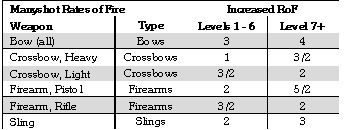
I was asked this in a couple emails so I'll post it here for anyone curious enough to look and see. One of the Fighting-man Combat Options, Manyshot, allows more attacks with a missile weapon at the expense of accuracy.Since all have different rates of fire, it's been asked time and again how many can be made when one has a base RoF of 2, another 1/2, etc. So it's been clarified and made simpler:
· Manyshot
(select missile type) - You can make a bonus missile weapon attack each
round with one type of missile launcher you are proficient with by hurrying
your reload at the expense of accuracy. All of your attacks suffer a -2 penalty
‘to hit’ with the exception of the final attack you make in the round, that
being made at a -4 penalty.
New Cleric Spell - Undeath to Death
Undeath to Death
Spell Level: Cleric 3
Range: Self
Duration: Instant
When the Cleric holds his
holy symbol aloft and utters the prayers of his Deity, a wave of divine energy
issues forth. All undead in a 30 ft radius of the Cleric suffers 1d4 points of
damage per caster level (maximum of 10d4), with a Toughness saving throw allowed
for half damage. Any undead of HD under half the Cleric’s level that are killed
are turned to dust.
Saturday, February 02, 2013
More uses for Spell Slots in a Vancian World
I don't know about all gamers or other people's games, but from playing D&D for over 30 years I know this has happened to me more than a few times...my favorite class are Magic-users (Wizards, Arcanists, Arcane Spellcasters, however you want to call them). Being that 1st level noob to the career is always fun when you find ways to make your cantrips last, load up on normal gear and find interesting ways to use a wet bedroll, 10 ft of rope and a 10 ft pole to confound your enemies and amaze your friends. To say the least, having a vancian spell casting system makes you think hard not only in spell selection, but how to survive without spells too.
There comes a time though, if your lucky and smart, where you reach the level when your character is ready for the heady power of a 2nd level spell...and you don't have any. Back in the day the Referees I've played under have run the gamut from 'tough luck' to allowing the use of the spell slot for lower level spells and adding some wild effects. In more recent years I've toyed with the extra effects for using a higher powered slot for lower level spells. When 3e came out it provided more of a template for what those slots can do (via Metamagic feats). Now don't turn your nose up Gentle Reader! While 3e may have been a departure from D&D (only in my own humble opinion) it took alot of things from what WAS in many homegrown D&D campaigns. So presented here is one such retro system that grants more felxability to those spell casters that may be suffering from a small spell selection, hopefully allowing them to remain useful for their party.
As a side note, we've allowed this for all spellcasting classes (including Clerics). While it might not seem like much use, it is impressive when a Cleric uses a 4th level slot to make a Cure Light Wounds spell into a range 30ft magic that increases the healing done by +50% and can be cast even while silenced, allowing him to keep an ally on his feet that's in melee while he guards the Magic-user.
Mixing Spell
Slots
If a player wishes to do so, he may use higher
level spell slots to memorize lower level spells by exchanging the slots (not the spell’s level vs the spell slot
level used to memorize it) on a 1-for-1 basis. For example, an Arcanist (3rd
level Magic-user) could use his 2nd level spell slot to memorize a 1st or 2nd
level spell if he desired to.
If a spell is memorized in a slot 1 level higher
than normal the caster can apply one of the following effects:
·
Increase
the base duration of a spell by 50%.
·
Inflict
a -2 penalty on saving throws against the spell’s effect.
·
Increase
the range of a spell by 50% or give a touch spell a range of 30 ft.
·
Remove
the need to use somatic (gestures) or the need to recite the spell’s chant to
cast.
If a spell is memorized in a slot 2 levels higher
than normal, the caster can apply one of the following effects:
·
Apply
any 2 separate effects from above.
·
Change
the area of area effect spells to a cone, cube or diameter of the same size.
·
Increase
all dice effects of a spell by 50%.
·
If
the spell deals elemental (Cold, Fire or Lightning) damage, change it to
another element.
·
Inflict
a -3 penalty on saving throws against the spell’s effect.
If a spell is memorized in a slot 3 levels higher
than normal, the caster can apply one of the following effects:
·
Apply
any 2 separate effects from above.
·
Double
the area of effect.
·
Increase
all dice effects of a spell by 100%.
·
Increase
the range of a spell by 100% or give a touch spell a range of 60 ft.
·
Inflict
a -4 penalty on saving throws against the spell’s effect.
A couple more Combat Options
In addition to the Fighting-man Combat Options presented here: Fighting-man Combat Options, presented are 2 more for your campaigns (should you use them)
- Defensive Strike - If you are using the total defensive action and an enemy misses you in melee combat, you may make an immediate free attack on him. You can do this a number of times each round equal to your number of melee attacks.
- Expert Tactician - When in melee with an enemy and you have an ally also in melee with the same opponent, you gain the same benefit as if you are flanking (even if you are not).
Saturday, December 08, 2012
New Spell - Empowered Turning
Empowered Turning
Cleric 2
Range: Self
Duration: 48 turns (8 hours)
Upon casting this spell, the Cleric infuses more holy power into his Turning attempts. For the spell's duration, the character's Turn Undead checks gains a bonus equal to half the character's Cleric level (to a maximum of +4) and the number Hit Dice affected increases by +50%.
Cleric 2
Range: Self
Duration: 48 turns (8 hours)
Upon casting this spell, the Cleric infuses more holy power into his Turning attempts. For the spell's duration, the character's Turn Undead checks gains a bonus equal to half the character's Cleric level (to a maximum of +4) and the number Hit Dice affected increases by +50%.
Tuesday, September 18, 2012
More simple Critical Hits
We've been playing with critical hits for a long time now, my group used the 'score a natural 20 and roll your damage twice, totalling them together' kind of rule for critical hits. I see critical hits as a way to do extra damage in whats an already abstract combat system, not a chance to do extra damage. The chance comes from the attack roll to me. The problem arises when the player, through the good fortune to roll that 20, rolls minimum or near minumum on his damage roll (same goes for my monsters, while not out to kill my player's characters on a malicious whim, I get a bit excited too when I roll that 20 and deflated that it does 2 or 3 points of damage).
We started playing with a new rule and its been working well thus far on both sides of the table:
Critical Hits are scored on a natural 20. The character inflicts his normal damage with all attendant adjustments, plus additional damage equal to half his Strength score (for melee attacks), his Dexterity score (for missile attacks) or his Charisma (for spell attacks, after any saving throws to reduce damage are made).
The simplest rationale for melee and missile attacks are that those 2 ability scores affect those forms of combat already, so we keep them in-house, so to speak. The choice of Charisma is that while Intelligence and Wisdom give you the ability to cast Arcane and Divine magic, the caster's force of will to bend the supernatural to his desires is an aspect of Charisma (how many people have you heard about that don't seem exceptionally beautiful or even good-looking, but you just feel they have some kind of presence). That's my rationale and its worked good so far.
For monsters, I use average stats:
- Smaller than Man-size - Strength 6, Dexterity 14, Charisma 10
- Man-size - Strength 10, Dexterity 10, Charisma 10
- Larger than Man-size - Strength 14, Dexterity 8, Charisma 10
- Giant-size - Strength 18, Dexterity 6, Charisma 10
In the case of giants hurling boulders, those are more like catapults firing at hobbits - here isn't a whole lot of careful aiming to do when hurling a rock larger than your target, your lobbing it in the general vicinity. Charisma is considered average unless you want to roll 3d6 for each spellcaster.
Monday, June 25, 2012
Onn Revised Core Rules: Bard
The Bard (Fighting-man Subclass)
Hit Dice Type:
|
d6.
|
Armor/Shield Permitted:
|
Light armor; Light and Medium shields.
|
Weapons Permitted:
|
Any 1-handed melee weapon; Light Crossbow, Dart,
Firearm (Pistol),
Short Bow, Sling.
|
Prime Attribute
|
Strength and Charisma.
|
Starting Gold:
|
3d6x10gp.
|
Bards are
collectors of lore and knowledge, travelling minstrels who hire for
entertainment for their supper, explorers of far off lands and more. Bards
travel far and wide, carrying with them the knowledge they glean from the
places they visit and spread word of events great and small from town to town.
Most of the tales a Bard shares with the populace at large is of the common
variety, stories of great battles, or a masterful hunt by some petty lord,
gossip of the court ladies and the like. Adventurers however, can learn some
interesting facts about creatures, lore of a local dungeon or rumors of
adventures to be had in nearby towns. On occasion, a Bard will offer to
accompany, or allow himself to be hired to a band of adventures in order to
create a new tale and gain more knowledge he can use.
The Bard is
generally a charismatic individual and must possess at least a 10 Strength and
12 Dexterity and Charisma. As Bards progress in experience, they gain several
abilities and are able to produce magical effects through their music, song and
tales.
Bard Class Abilities
Bard’s Ear (1st level): Bards are attuned to sounds and noises and the tuning/playing of
musical instruments. Whenever a Bard is the subject of discerning noises or
performing, they gain a +2 bonus to any die rolls.
Disarming Charm (1st level): Bards are personable and gain a +2 bonus to any die rolls involving
influencing the reactions of others.
Fighting-man Combat Options (1st Level): Bards have one combat option at 1st level, gaining another at 5th level
and every 5 levels thereafter. See the Fighting-man Class for details.
Haphazard Lore (1st level): The Bard is a repository of various tidbits of knowledge and lore from
his wanderer lifestyle and can attempt to glean information from examining an
item, creature, object or writing. The Bard generally has a +1 bonus to any die
rolls to glean information. At 4th level and greater this becomes a +2 bonus
and at 9th level and greater he possesses a +3 bonus.
Heroic Performance (1st level): Bards have the ability to cause almost magical-like effects through the
use of music, song, recitation, dance, brazenly combating foes with panache and
the like that affect allies or enemies (depending on the effect generated).
Heroic Performance can be used 3 times per day, plus the Bard’s Charisma
adjustment. Unless noted otherwise effects last until the Bard ceases
performing (maximum of 1 round per level, plus the Bard’s Charisma adjustment).
·
Captivate: The Bard can capture and hold the attention of 1d6
enemies plus his Charisma adjustment in a 30 ft radius, beginning with the
closest to the farthest. If the monsters fail Ego saving throws they cease
attacking but will still defend themselves until the effect ends.
·
Countersong: The Bard can suppress the effects of other
creatures’ sound-based mind effects, such as a harpy’s charm, in a 30
ft radius around himself. If the creator of the sound-effect is within 30 ft of
the Bard and fails an Ego saving throw, the effect is broken and cannot be
reestablished until the Bard stops performing. Requires a sound-based type of
performance.
·
Hero’s Luck: Allies within a 30 ft radius that can see and hear
the Bard are affected, gaining a +1 bonus to saving throws and ‘to hit’ rolls.
At 6th and higher levels this becomes a +2 bonus.
·
Hindering Magic: All spell casters within
30 ft of the Bard attempting to cast spells must succeed at an Ego saving throw
with the Bard’s Charisma adjustment applied as a penalty. Failure means the
spell is lost with no effect.
·
Rally: Companions of the Bard fighting within 30 ft of
him gain a +2 bonus to morale and reroll any failed morale checks while under
this effect. At 7th and higher levels this bonus becomes +4.
·
Song Spell: At 1st level the Bard can emulate any Healing,
non-combat Illusion or Charm spell of 1st level with a use of Heroic
Performance. Every 4 levels beyond 1st level (5th, 9th, etc) an additional
spell level may be emulated.
·
Wayland’s Tune: If the Bard performs at least half the day while
travelling, his group travels 50% farther than normal. One use of Heroic
Performance will suffice to cover the day of travel.
Magic Item Enhancement (1st level): Bards playing any magical instrument gain a 50% greater result and can
activate it an additional time if it has limited uses per day or week, with no
penalty.
Weapon Mastery (1st level): At 1st level the Bard begins with 4 weapon slots, gaining
additional slots at 4th level and every 3 levels thereafter. See the
Fighting-man class for details.
Bonus Languages (3rd level): Because of their knack for picking up sounds and widely traveled
lifestyles, Bards are also masters of linguistics. Bards may add an additional
Language to their Languages list at every 3rd level (3rd, 6th, 9th, etc).
Decipher Writing (4th level): Bards can determine the contents of written messages, and have a +2
bonus to any die rolls to decipher any written non-magical language they
encounter. They may read all spell scrolls, but suffer a 10% chance per spell
level of a backfire or miscast. The exact effects are determined by the
Referee.
Establish a Stronghold (9th level): A Bard can establish a stronghold in the same way as a Fighting-man. This will more resemble a college, academy, museum or library since it will be more of a center of learning than a fortified keep (although centers of learning in the wilderness can be actual keeps or fortresses for protective purposes). Followers numbering 3-36 will be attracted to the school as well as prospective Bards and sages wishing to learn from the character.
Level
|
Title
|
Experience
|
Hit Dice
|
1
|
Wanderer
|
0
|
1
|
2
|
Rhymer
|
1,625
|
2
|
3
|
Sonneteer
|
3,250
|
3
|
4
|
Lyrist
|
7,500
|
4
|
5
|
Skald
|
15,000
|
5
|
6
|
Troubadour
|
30,000
|
6
|
7
|
Minstrel
|
60,000
|
7
|
8
|
Muse
|
90,000
|
8
|
9
|
Bard
|
120,000
|
9
|
10
|
Bard
|
240,000
|
-
|
11
|
Bard
|
360,000
|
10
|
12
|
Bard
|
480,000
|
-
|
13
|
Bard
|
600,000
|
11
|
14
|
Bard
|
720,000
|
-
|
15
|
Master Bard
|
840,000
|
12
|
16
|
Master Bard
|
960,000
|
-
|
17
|
Master Bard
|
1,080,000
|
13
|
18
|
Master Bard
|
1,200,000
|
-
|
19
|
Master Bard
|
1,320,000
|
14
|
20
|
Master Bard
|
1,440,000
|
-
|
Subscribe to:
Posts (Atom)